The boundary of the stripe domain region expands just like a domain wall when it is driven by a magnetic field and the velocity follows the creep law which is consistent with typical domain walls.
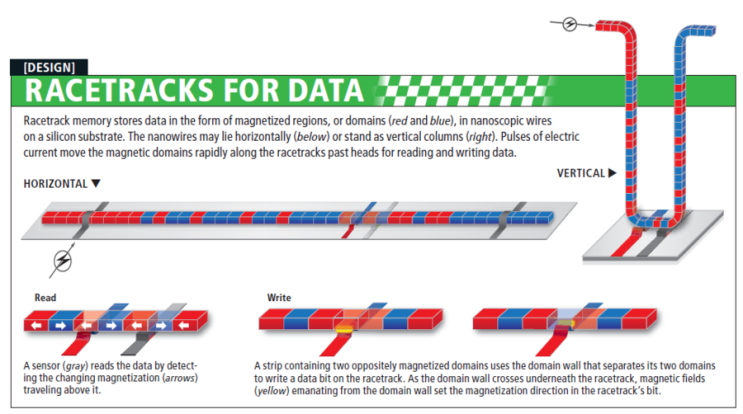
Magnetic domain wall strip.
A magnetic domain wall the boundary region between two magnetic domains with different magnetization orientations with nanoscale confinement can be considered as a particle trapped in a pinning potential well.
B differential kerr images of magnetic domain wall displacement under a magnetic field of 2 6 mt and gate voltages of 1 0 and 0 8 v.
Here we provide a theoretical description of dw dynamics in fim strips based on an extended collective coordinates model 1dm.
The domain wall thickness depends on the anisotropy of the material but on average spans across around 100 150 atoms.
On the dynamics of the domain wall in a ferromagnetic strip.
Adapted from lin et al.
A schematic representation of the e field magnetic device incorporating a mgo tio2 composite dielectric barrier.
The resulting magnetic.
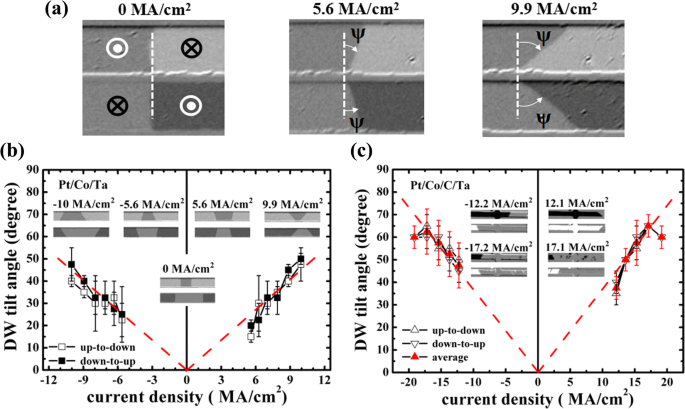
The domain wall was driven by an applied magnetic field.
Martinez current driven domain wall dynamics in ferromagnetic layers synthetically exchange coupled by a spacer.
The strip consists of two uniformly magnetized domains separated by a bloch wall.
Domain walls a bloch wall b neel wall c cross tie wall 2.
Magnetic domains a uniaxial wall spacing b closure domain c stripe domains 3.
Some methods for the domain observation a sempa b mfm c magneto optical 2.
Magnetic domain and domain walls 1.
A domain wall is a gradual reorientation of individual moments across a finite distance.
The boundary of the stripe domain region expand just like a domain wall when it is driven by magnetic field and the velocity follow the creep law which is consistent with the typical domain wall.
Magnetic domain and domain walls 1.
The repeat number and magnetic layer thickness have an obvious effect on the size of the stripe domain.
In magnetism a domain wall is an interface separating magnetic domains it is a transition between different magnetic moments and usually undergoes an angular displacement of 90 or 180.
Its dynamic response to external factors such as applied magnetic fields or electrical currents depend heavily on the structure of the domain wall.
The project exploits the use of computer simulations to replicate a physical experiment.
The period and magnetic layer thickness have obvious effect on the size of the stripe domain.
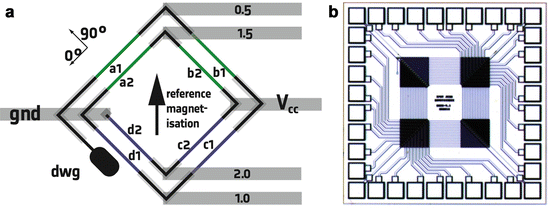
The strips are made with a curved shape to easily set a domain wall in the bent region after the application of an external magnetic field transverse to the strip 27 28.